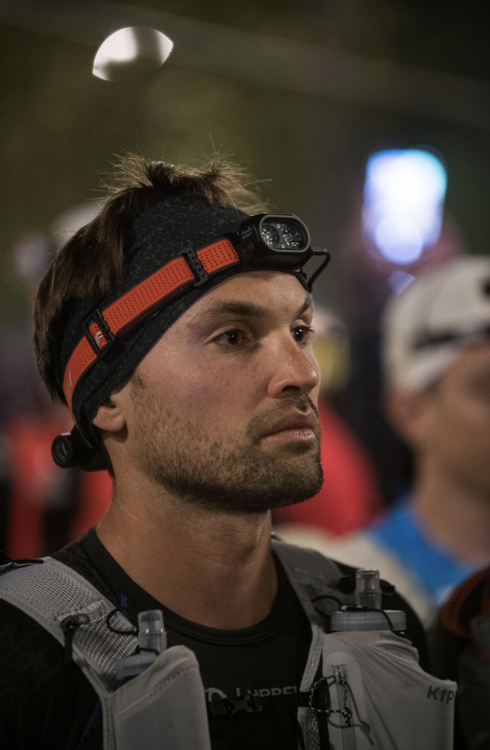
Carlos Regatero, Head of PE - What running a 100km ultra-marathon through the Sierra Nevada taught me about passion, resilience, and the people who make it possible
At 10 pm on a warm April night, I stood at a start line in Granada, Spain, about to attempt something that most people — myself included— would have called unthinkable. One hundred kilometres through the Sierra Nevada mountains. Over 5,500 metres of climbing. Snow, wind gusts of up to 50 kilometres per hour, and temperatures that swung from a summer evening to a high-altitude storm in the same race.
The Ultra Sierra Nevada is considered one of the most challenging ultra-endurance races in Europe. The race begins at night, so you spend the entire darkness on mountain trails, your world reduced to a small circle of light. By the time dawn breaks, you might expect the hardest part to be behind you — it is not. From kilometre 60, the course tilts relentlessly upward. The final ten kilometres are a vertical ascent through snow at over 3,000 metres, where the air thins and the gap between what you want to do and what your body can do narrows in ways you cannot prepare for until you are in it.
I finished in 16 hours. But the race, if I'm honest, was the easy part.
The System Behind the Dream
There is a quote I kept returning to throughout this journey: "You don't rise to the level of your goals, you fall to the level of your systems." I understood it intellectually long before I signed up. I only truly felt it — in my legs, my lungs, my sleep-deprived 5am brain — when training began in September 2025.
A goal, on its own, is just a wish. What turned this one into a finish line was seven months of unglamorous, non-negotiable commitment: four runs a week, three strength sessions, early alarms at weekends, evening runs after full days of teaching. I trained in the rain on purpose, because the Sierra Nevada would be wet. I ran at night, because the race starts at 10pm. I worked to condition my body to see discomfort as normal, rather than alarming. I said no to things I wanted to do, and kept going even on the days when nothing seemed to click.
That is what obsession actually looks like — and I want to reclaim the word. Obsession has an extreme edge, a suggestion of imbalance. But what I experienced gave me more energy, focus, and joy than almost anything else in my adult life. Obsession, in the way I mean it, is not the absence of perspective. It is the presence of something that matters deeply enough to organise your life around. When that north star is something you have chosen freely, something that demands the best of you — it does not deplete you. It fuels everything else.
Not How You Start, But How You Finish
I had prepared for suffering. Two hours in — of an expected eighteen — I developed severe stomach pain. I knew what to do: dissolve calories in water, keep moving, wait. The pain passed. Later, my knee began to protest on the descents. I modified my stride and kept going. At the highest points, we ran through snow and driven rain into winds that made every step a negotiation.
“I did not have a perfect race. But I had a good finish. I have come to believe that is the part that counts — in running, in teaching, and in everything in between.”
And then something shifted. Past the halfway point, after the rough start, everything began to click. My body found its rhythm, my stomach settled, and I started to feel — genuinely — that I could rely on the months of preparation I had put in. The training was working. That feeling, of trusting your system when it matters most, is one I will not forget. In the final and hardest section of the race, running on legs that had already covered 80 kilometres, we overtook more than twenty runners. Not because I had more left in the tank — but because I had prepared for exactly this moment.
So much of life rewards the person who finishes well over the person who starts well. The finish is built on grit, on systems, and on the quiet stubbornness to keep moving when the only reason left is the one you committed to months ago.
This experience made me a different kind of teacher. I talk about resilience constantly, but there is a difference students feel immediately between someone who talks about it and someone who lives it. When I stand in front of a student convinced they cannot do something, I now speak from a place I did not have before. I know, in my body, that I cannot do this is almost never the truth. It is just a data point — and you are allowed to disagree with it.
Tell People
There is one thing I feel most strongly about sharing: tell people your goals.
Tell the people you love. Tell your colleagues. Tell anyone who will listen — especially those whose opinion of you matters. Not because you need their validation, but because saying "I am going to do this" out loud transforms a private wish into a public commitment. And public commitments are infinitely harder to abandon.
I was completely transparent about this challenge from the moment I signed up. My family knew. My colleagues at BSL knew. My students knew. Some thought it was an enormous amount to take on. Others became genuinely invested — checking in after long runs, following the race online. When my family showed up at the 70km checkpoint holding a sign that read "Que locura, que orgullo" — what madness, what pride — it was not just a beautiful moment. It was the physical manifestation of seven months of shared commitment.
Do not scale your goals down to sound more reasonable. The bigger and stranger they sound, the more important it is to say them out loud — because those are the goals that most need the weight of other people's knowledge to keep you tethered when motivation dips.
Your loved ones cannot support what they do not know about.
A final word for my community. None of this would have felt the same without the BSL community behind me. From colleagues who checked in after training runs and asked how the preparation was going, to the leadership team who took a genuine interest and gave this challenge recognition. That kind of environment, where people's passions and lives outside of school are valued and celebrated, is not something to take for granted. I am grateful to work in one.